Landscape Lighting in Westlake Hills: A Summer Guide
Summer evenings in Westlake Hills are made for sitting outside, once the sun finally drops and the heat lets go a little. That's exactly when a well-lit yard earns its keep. Outdoor Renovations has spent years designing and installing landscape lighting across Travis County, and we know this part of Texas has its own quirks — limestone-heavy soil, mature oak canopies, and steep lot grades that change how light behaves after dark. This guide walks through what landscape lighting really involves, why summer is a smart time to think about it, and what separates a lighting system that lasts from one that fails in two years.
Landscape Lighting Guide for Westlake Hills Homeowners Landscape lighting uses low-voltage fixtures to highlight trees, walkways, and architecture while improving nighttime safety. In Westlake Hills, where lots often sit on sloped, tree-covered terrain, good lighting design accounts for limestone soil, root protection, and long sightlines down driveways and steps. Summer is prime time to use your outdoor space after dark once temperatures drop below the triple digits. Homeowners should know that fixture quality, transformer sizing, and wire placement matter more than the number of lights you install.
Why Landscape Lighting Matters More in a Central Texas Summer
When it's 103°F at 4 p.m., nobody's grilling on the patio. But by 8 or 9 p.m., once the heat breaks a bit, that's prime time for outdoor living in Westlake Hills. A good lighting system is what makes that window usable and safe.
Think about your own yard. Stone steps, pool edges, retaining walls, and sloped driveways all turn into hazards once the sun goes down. Westlake Hills has more elevation change than most Austin neighborhoods, and that means more transition points where someone can trip in the dark.
There's a curb appeal angle too. A house with thoughtful lighting on its trees and entry reads as cared-for, even at 10 p.m. when nobody's supposed to be looking. Quality landscaping in general has been shown to add strong value to a home over time, and lighting is one of the more affordable ways to add that polish without a full landscape design overhaul.
Key Takeaway: Summer heat pushes outdoor living into the evening hours, and that's exactly when your landscape lighting does its job. In Westlake Hills, where terrain changes are common, lighting isn't just about looks — it's a safety feature for steps, slopes, and pool areas.
How Landscape Lighting Design Actually Works
A lot of homeowners think landscape lighting means sticking a few solar stake lights along the walkway. That's not design — that's decoration. Real lighting design starts with how you actually use your yard at night, then builds a plan around it.
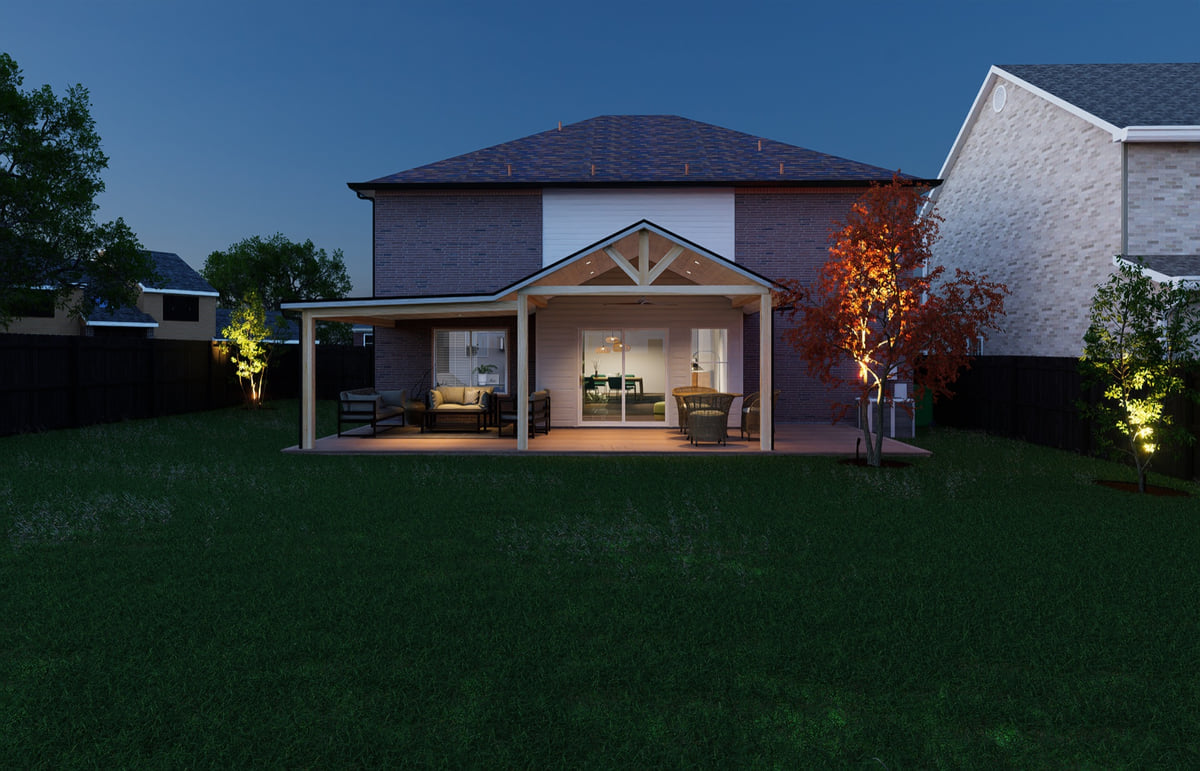
In Kyle Stoutenger's experience, the biggest mistake he sees from DIY attempts and even some other contractors is over-lighting. People want everything bright, and the yard ends up looking like a parking lot instead of a home. Good lighting design uses contrast — dark space next to lit space — to create depth. You light the tree canopy, the stone wall, the steps. You leave the lawn and other areas dim. That contrast is what makes a yard look layered instead of flat.
There are a few core lighting types we use on almost every project:
- Path lights — low fixtures that light walkways at ankle height, spaced to avoid glare into your eyes
- Well lights — flush-mounted fixtures that sit in the ground and aim straight up into a tree canopy or against a wall
- Spotlights — angled fixtures that wash light across a facade, tree, or piece of stonework
- Downlights — mounted higher in trees to mimic natural moonlight falling through branches
The layout depends on your property's terrain. Westlake Hills lots often have mature live oaks and cedar elms with wide canopies, and those trees are some of the best lighting subjects we work with. A single well light aimed up into a live oak canopy at night creates a dramatic look that a dozen path lights never will.
Key Takeaway: Good lighting design creates contrast and depth instead of flooding the whole yard with brightness. Mature trees, stone walls, and elevation changes common in Westlake Hills give a lighting designer plenty to work with.
The Technical Side: Wiring, Transformers, and Fixture Quality
This is where a lot of lighting jobs go wrong, and it's usually invisible until year two or three. Landscape lighting runs on low-voltage current, stepped down from your home's standard power through a transformer. That transformer needs to be sized correctly for the total wattage load of your system, with room to add fixtures later. Undersized transformers cause voltage drop, where fixtures farther from the transformer get noticeably dimmer than ones close to it.
Wire gauge matters just as much. Thinner wire loses voltage over distance faster than heavier gauge wire. On a large Westlake Hills lot with lighting runs stretching across a sloped property, using the wrong gauge means your farthest fixtures might barely glow while the closest ones are fine. A contractor who understands voltage drop calculations designs the wire runs and gauge choices around your property's actual size and layout, not a generic kit.
Fixture housing quality is another area where corners get cut. Cheap composite or thin-plastic housings can crack, fade, or warp after a few summers of direct Central Texas sun exposure and UV load. Brass, copper, and heavy-duty composite housings hold up far better over time and are worth the extra upfront cost. This is a case where paying more once beats replacing fixtures every couple of years.
Wire burial depth and placement around root zones is another detail that separates careful installers from ones who rush the job. Around mature oaks, we hand-dig or use low-impact methods to avoid cutting through major roots, since root damage can stress a tree for years before it shows above ground. This ties directly into the kind of root-aware thinking we bring to softscaping and planting work too — the soil and root systems in Westlake Hills' limestone-heavy ground demand a careful hand.
Key Takeaway: Voltage drop, wire gauge, and fixture housing quality determine whether your lighting system still looks great in five years or needs constant repairs. These details matter more than the number of fixtures you install.
Smart Controls and Water Restrictions: Why They're Connected
You might not think landscape lighting has much to do with irrigation, but on a lot of our Westlake Hills projects, they run through similar smart-control thinking. Smart transformers let you schedule lighting zones, adjust for daylight savings automatically, and control everything from a phone app instead of a manual timer.
This matters more in summer, when daylight hours stretch later and your lighting schedule needs to shift with them. A smart controller adjusts automatically instead of leaving your lights on too early or too late.
The same logic applies to your irrigation system right now. With Austin Water enforcing mandatory water restrictions that apply year-round, and summer heat pushing landscapes to their limit, this is a good week to check that your irrigation and drainage system and smart controllers are actually working. Smart irrigation controllers can cut water use significantly compared to manual systems, which matters when every drop counts under restriction rules. If you haven't checked your drip zones lately, do it before the next 100-degree stretch hits.
Key Takeaway: Smart controllers aren't just convenient — they help your lighting and irrigation systems adapt to summer's longer days and stricter water rules without you having to manage every setting by hand.
Common Misconceptions About Landscape Lighting
"More lights equal better lighting." This is probably the most common myth we run into. A yard with 30 fixtures scattered everywhere often looks worse than one with 12 fixtures placed with intention. Light needs dark space around it to have any visual impact.
"Solar lights are just as good as low-voltage wired systems." Solar stake lights have their place for a quick, cheap accent, but they can't match the brightness, consistency, or design flexibility of a wired low-voltage system. Solar output also drops in shaded areas, and Westlake Hills' mature tree canopy means a lot of your yard doesn't get full sun exposure anyway.
"Landscape lighting installation tears up the yard." Low-voltage wiring is shallow-buried and doesn't require the kind of excavation that hardscaping or drainage work needs. In Kyle Stoutenger's experience, most lighting installs leave minimal disruption to existing lawns and beds when done by someone who knows how to route wire efficiently.
"You can install it once and forget it." Bulbs burn out, fixtures shift after freeze-thaw cycles or soil movement from our expansive clay soils, and transformers need occasional checks. A system needs light annual maintenance, similar to how you'd check an irrigation and drainage system before summer.
Key Takeaway: The biggest misconceptions about landscape lighting all boil down to "more and cheaper is better." In practice, thoughtful placement and quality fixtures outperform quantity every time.
Pairing Lighting with Hardscaping and Carpentry Features
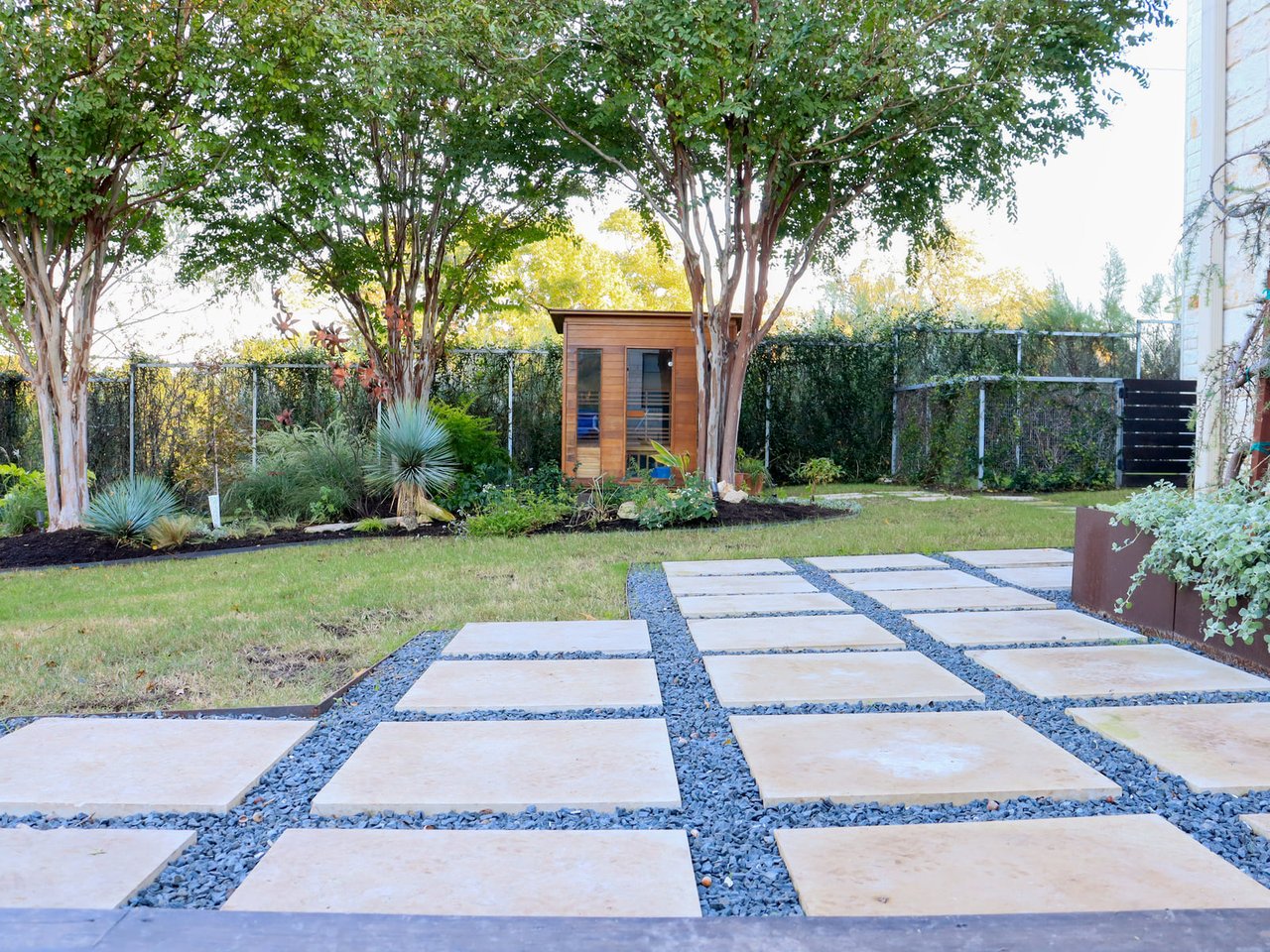
Landscape lighting rarely stands alone. It usually gets paired with other features on the property — a stone patio, a retaining wall, a pergola, or a deck. Lighting design should happen alongside these projects, not as an afterthought once the concrete's already poured.
If you're planning a new patio or outdoor kitchen through our hardscaping team, that's the time to run conduit for future lighting, even if you're not ready to install fixtures yet. It's far easier to bury a conduit sleeve under a patio before it's built than to cut into finished hardscape later.
The same goes for custom carpentry projects like pergolas and decks. String lighting, post lights, and integrated fixtures look best when they're planned into the structure's design from the start, with wiring routed cleanly through posts and beams instead of stapled on afterward.
Summer happens to be a good season for hardscape planning too, since installation can continue year-round in Central Texas — the only real limit is pouring concrete above 95°F, which we simply schedule around during early morning hours or cooler stretches.
Key Takeaway: Plan lighting alongside hardscaping and carpentry projects, not after. Running conduit early saves money and avoids cutting into finished stone or wood later.
What Homeowners in Westlake Hills Should Know Right Now
With highs near 103°F this week and little relief expected, this isn't the week to start major new plantings or pour concrete. But it is a great week to get a lighting consultation scheduled, check your existing fixtures for summer wear, and make sure your irrigation system is keeping your landscape alive under the heat.
Landscape lighting installation itself doesn't disturb soil or stress plants the way new plantings do, so it's actually one of the more summer-friendly projects on the list. If your current system has dim spots, flickering fixtures, or gaps in coverage, now's a good time to get it looked at before you're using your patio every evening for the next few months.
For homeowners across Travis County — whether you're in Rollingwood, Barton Creek, Tarrytown, or Bee Cave — the same principles apply. Terrain, tree canopy, and soil type all shape the right lighting plan for your specific property. You can also check out our portfolio to see the range of lighting and landscape work we've completed. For general guidance on native plants that pair well with accent lighting, the Lady Bird Johnson Wildflower Center and Texas A&M AgriLife Extension both offer solid resources on what grows well in our soil and climate.
Key Takeaway: Summer is a safe, practical time to install or upgrade landscape lighting, even while other landscape work pauses for the heat. It's also the season you'll get the most use out of it.
Ready to see your yard in a new light? Outdoor Renovations has been designing and installing landscape lighting across Westlake Hills and Central Texas, backed by Kyle Stoutenger's 16+ years of hands-on industry experience. We're fully bonded, insured, and back every job with a 1-year service guarantee. Give us a call at (512) 743-0570 or visit our contact page to schedule your free consultation today.
Landscape Lighting in Westlake Hills & Central Texas
Landscaping Services Near You
Frequently Asked Questions
What is the best time of year to install landscape lighting in Westlake Hills?
You can install landscape lighting almost any time of year, including summer, since it does not require digging deep trenches or pouring concrete. Fall and spring are ideal for pairing lighting with new plantings, but summer evenings are actually when homeowners notice how much they need it most.
How much does landscape lighting cost in Central Texas?
Cost depends on the number of fixtures, transformer size, and how much of the property you want to light. A good approach is a phased plan that starts with the front entry and key trees, then expands to the backyard and pathways over time. We provide custom quotes based on a site walk.
Will landscape lighting hurt my trees' roots during installation?
Not if it's installed correctly. Low-voltage wiring runs are shallow and we hand-dig or use a low-impact trenching method around root zones, especially near mature live oaks and cedar elms common in Westlake Hills. A contractor who understands local root structures will avoid major roots entirely.
Can landscape lighting survive Austin's extreme summer heat?
Quality fixtures rated for outdoor use are built to handle high heat, but cheap plastic housings can warp or fade under direct sun exposure over multiple summers. We use fixtures with metal or heavy-duty composite housings that hold up better in Central Texas conditions.
Do I need a permit for landscape lighting in Westlake Hills?
Low-voltage landscape lighting generally falls outside major permitting requirements, but any project tied to electrical service upgrades may need to follow local code. We handle the details so you don't have to track down the right office.
How do smart controllers work with landscape lighting?
Smart transformers and timers let you set schedules, adjust for seasonal daylight changes, and control zones from a phone app. This means your lights turn on at dusk and off at a set time automatically, without you touching a switch.
What's the difference between path lights, well lights, and spotlights?
Path lights sit low and light walkways at ankle height. Well lights sit flush with the ground and aim straight up, often used to highlight trees. Spotlights aim at an angle to wash light across a wall, tree canopy, or architectural feature. Most designs use a mix of all three.
Need Landscaping Service in Austin?
Contact Outdoor Renovations today for landscape lighting services in Austin, TX.